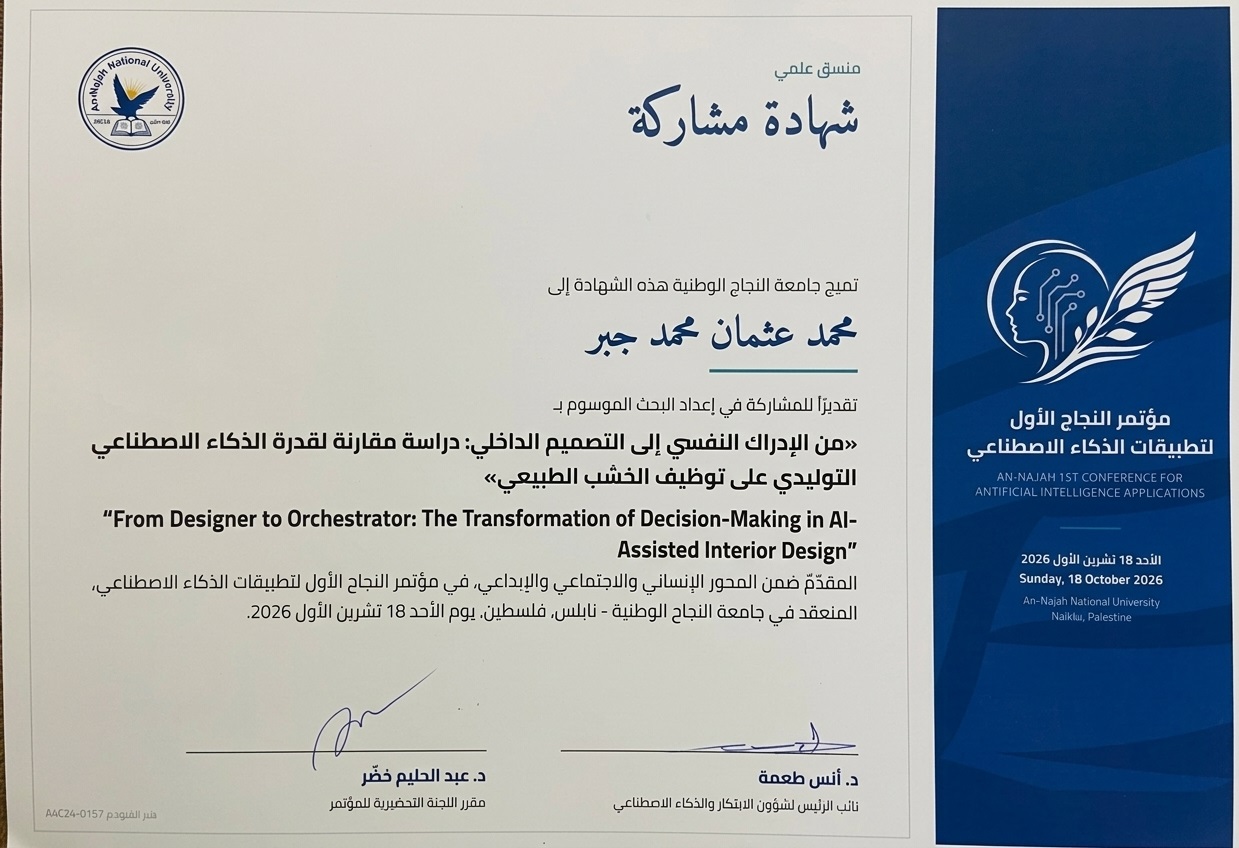
Dr. Mohammad Jabr, from the Faculty of Fine Arts at An-Najah National University, participated with two research papers in the First An-Najah Conference on Artificial Intelligence Applications, held on Sunday, October 18, 2026, at An-Najah National University in Nablus. His participation reflects the Faculty’s commitment to advancing academic research and exploring the applications of artificial intelligence in the fields of art and design.
The two research papers examined applications of artificial intelligence in interior design, focusing on transformations in the design decision-making process and exploring the potential of generative artificial intelligence in incorporating natural materials into interior environments. The studies highlight the growing integration of technology, human creativity, and psychological and aesthetic considerations in contemporary design.
First Research Paper: From Designer to Orchestrator: The Transformation of Decision-Making in AI-Assisted Interior Design
The first paper, entitled:
“From Designer to Orchestrator: The Transformation of Decision-Making in AI-Assisted Interior Design”
was authored by Dr. Mohammad Jabr, in collaboration with Dr. Hani Al-Faran and Master’s students Maisam Abdel Haq and Ruba Yaseen.
The study examines the transformations brought about by artificial intelligence tools to the role of the interior designer, particularly the shift from directly making and implementing design decisions toward guiding the creative process and managing the alternatives and options generated by intelligent systems.
It also highlights the evolving role of the designer as a director of the creative process and a coordinator of AI-generated outputs, while emphasizing the importance of human expertise, critical thinking, and aesthetic judgment in evaluating design alternatives and selecting solutions that meet the functional and aesthetic requirements of interior spaces.
Second Research Paper: From Psychological Perception to Interior Design: A Comparative Study of Generative AI’s Ability to Incorporate Natural Wood
The second paper was entitled:
“From Psychological Perception to Interior Design: A Comparative Study of Generative AI’s Ability to Incorporate Natural Wood.”
The study was prepared by Dr. Hani Al-Faran in collaboration with Dr. Mohammad Jabr, Dr. Ashraf Al-Sayigh, and Master’s students Ibtisam Saimeh and Rania Sarsour.
The paper explores the potential of generative artificial intelligence in incorporating natural wood into interior design by examining the relationship between psychological perception and design choices, while investigating the ability of these technologies to support the development of design treatments involving natural materials.
It also examines the importance of integrating psychological understanding of interior environments with the capabilities offered by artificial intelligence tools to generate design alternatives and explore innovative solutions for incorporating natural wood into interior spaces. This approach enhances the interaction between the material and aesthetic qualities of wood and the human experience of the space.
Dr. Mohammad Jabr’s participation in the two research papers reflects a research-oriented approach to exploring the future of interior design in light of the transformations driven by artificial intelligence, while opening new avenues for integration between technology, the arts, and the humanities. It also contributes to advancing design knowledge and practice and strengthening the role of academic research in responding to the rapidly evolving digital landscape of contemporary design.


